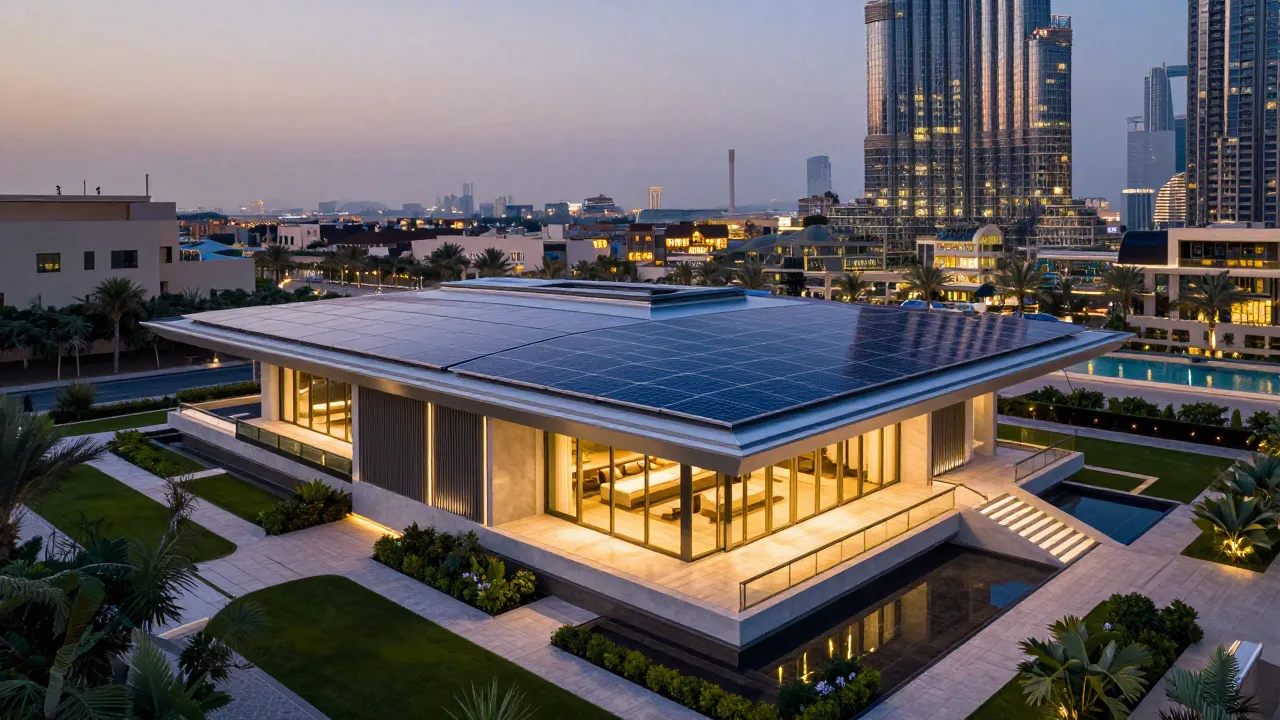
Forget the gold-plated fixtures. The new currency of Dubai's luxury real estate is measured in kilowatt-hours and carbon offsets. The elite aren't just reducing their footprint—they're erasing their DEWA bill entirely. Welcome to the era of the Net-Zero Villa.
Executive Summary
Post-COP28 and stringent new DEWA regulations have transformed sustainability from a niche concern into the ultimate status symbol. The 'Net-Zero Villa'—a high-performance asset generating as much energy as it consumes—is now the benchmark for Dubai's luxury residential market, delivering complete utility bill independence and commanding a 12-18% premium on resale value.
The Data Behind the Demand
The shift is quantifiable. Searches for "solar villas Dubai" have increased 340% year-on-year. DEWA's Shams Dubai initiative reports a 200% increase in residential solar connections among premium communities like Emirates Hills and Al Barari. This isn't environmentalism—it's astute financial strategy.
A standard 7,000 sq. ft. villa in Dubai Hills consumes approximately 45,000 kWh annually. At current DEWA rates, that's an annual bill north of AED 25,000. The Net-Zero Villa doesn't just reduce this cost; it nullifies it.
Average Annual DEWA Bill for a Net-Zero Spec Villa
Premium on Resale Value vs. Non-Sustainable Equivalent
Architecting the Net-Zero Blueprint
Achieving net-zero is a symphony of technology and design, not a single feature. It requires a holistic integration of five core systems.
- Photovoltaic Skin: Beyond rooftop panels. We're specifying building-integrated photovoltaics (BIPV)—solar cells embedded within the villa's glass facades and roofing tiles. Aesthetically seamless, technologically superior.
- Smart Thermal Envelope: Advanced aerogel insulation, electrochromic windows that tint automatically, and phase-change materials in walls absorb heat during the day and release it at night.
- AI-Powered Climate Management: Systems that learn occupancy patterns, pre-cool spaces using off-peak solar storage, and integrate with the DEWA grid to sell excess energy back during peak demand.
- Water Reclamation Nexus: Greywater recycling for landscaping and blackwater treatment via compact, odorless biodigesters. Reducing water-related energy consumption by up to 40%.
- Embodied Carbon Accounting: Using low-carbon concrete, locally sourced stone, and certified sustainable timber. The premium materials of tomorrow are defined by their provenance and footprint.
Case Study: The Al Hekma District Retrofit
A portfolio of 12 legacy villas underwent our Net-Zero transformation in 2025. The average capital outlay was AED 550,000 per villa. The ROI? Elimination of all utility costs (AED 25k+ annually) and an average valuation increase of AED 2.1 million per asset within 8 months. The math is unequivocal.
The Communities Leading the Charge
This revolution is geographically focused. Sustainable luxury has its epicenters.
Al Barari: The pioneer. Its dense landscaping creates a micro-climate, reducing cooling loads by 15% before technology is even applied.
Dubai Hills Estate: New phases are being master-planned with district cooling fed by centralized solar farms.
Emirates Hills: The retrofit capital. Owners are not just competing with views, but with whose villa has the highest positive energy rating.
The Sustainable City: Proof of concept at scale. Its success has permanently shifted buyer expectations across all Emirates.
Payback Period for Full Net-Zero Retrofit
Average Value Uplift for a Net-Zero Spec Villa (2025 Data)
Is your current asset underperforming? The sustainable premium is no longer speculative—it's the market baseline. Let our Intelligence Division model the Net-Zero potential for your portfolio.
Secure DIFC Consultation#SustainableLiving #EcoLuxury #DubaiVillas #GreenUAE #SmartHomeDubai
Professional Insights (0)
Share Your UAE Perspective
Join the conversation with Dubai's investment community
No insights yet
Be the first to share your UAE market perspective